
DevDeer TechLoading
AI-Automation
 Kaies Mahmud Nehal5 min read
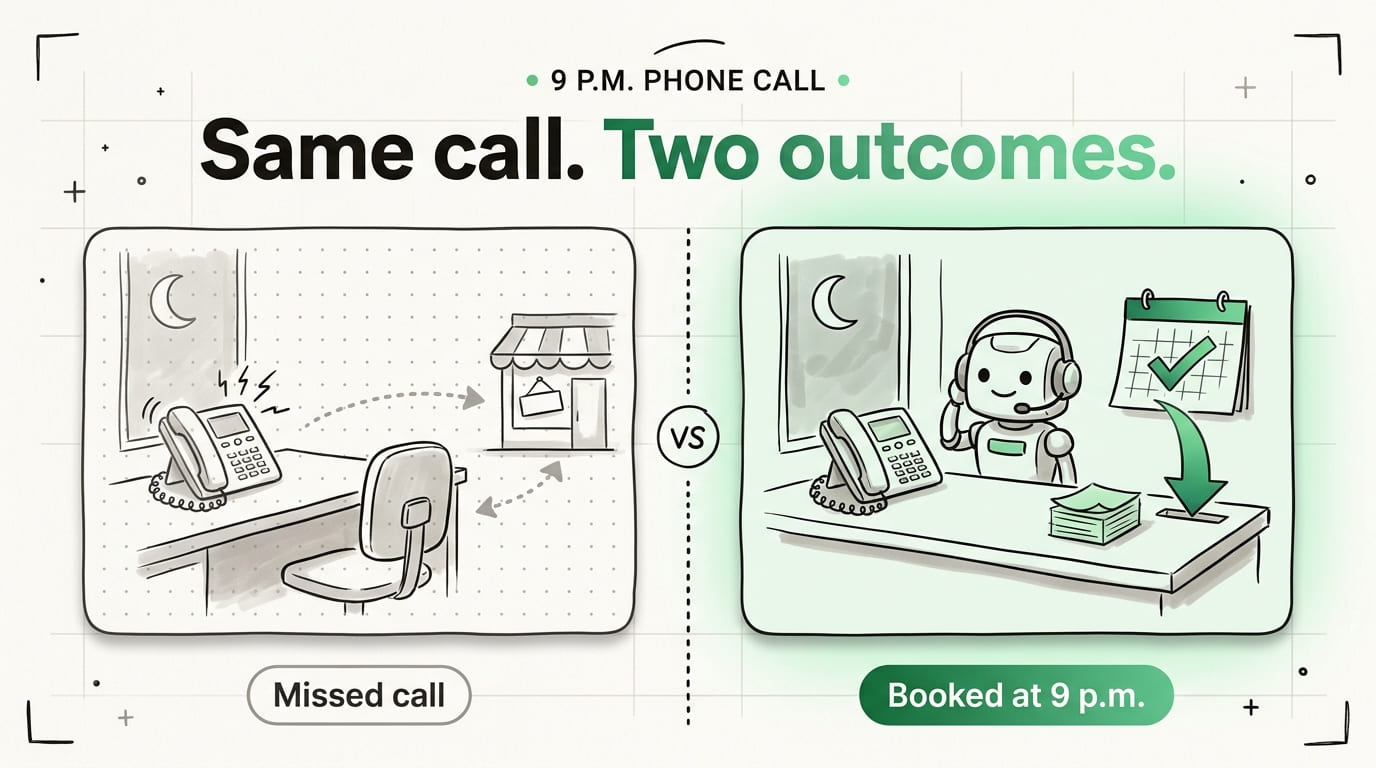
Your phone rings at 9 p.m. Nobody picks up. The caller does not leave a voicemail. They search again and call your competitor, who answers in two rings.
This happens in almost every small business. You close up, the team goes home, and the phone keeps ringing. An AI receptionist is built for exactly this gap. It is a voice or chat assistant that answers for you at any hour, using the facts you give it.
But it is not magic, and it is not a person. Some owners expect it to run the whole front desk and get disappointed. Others reject it after hearing one bad story. The truth sits in the middle. This guide explains what an AI receptionist does well, where it fails, which rules you must follow, and how to set one up so it helps instead of hurts.
It is software that talks to your customers on the phone, on your website chat, or on apps like WhatsApp. It understands what the person is asking, answers from the information you gave it, and then takes an action: book a time, take a message, or pass the call to you.
Think of it as a very patient first responder that never sleeps. It is quick and polite, but it only knows what you taught it.
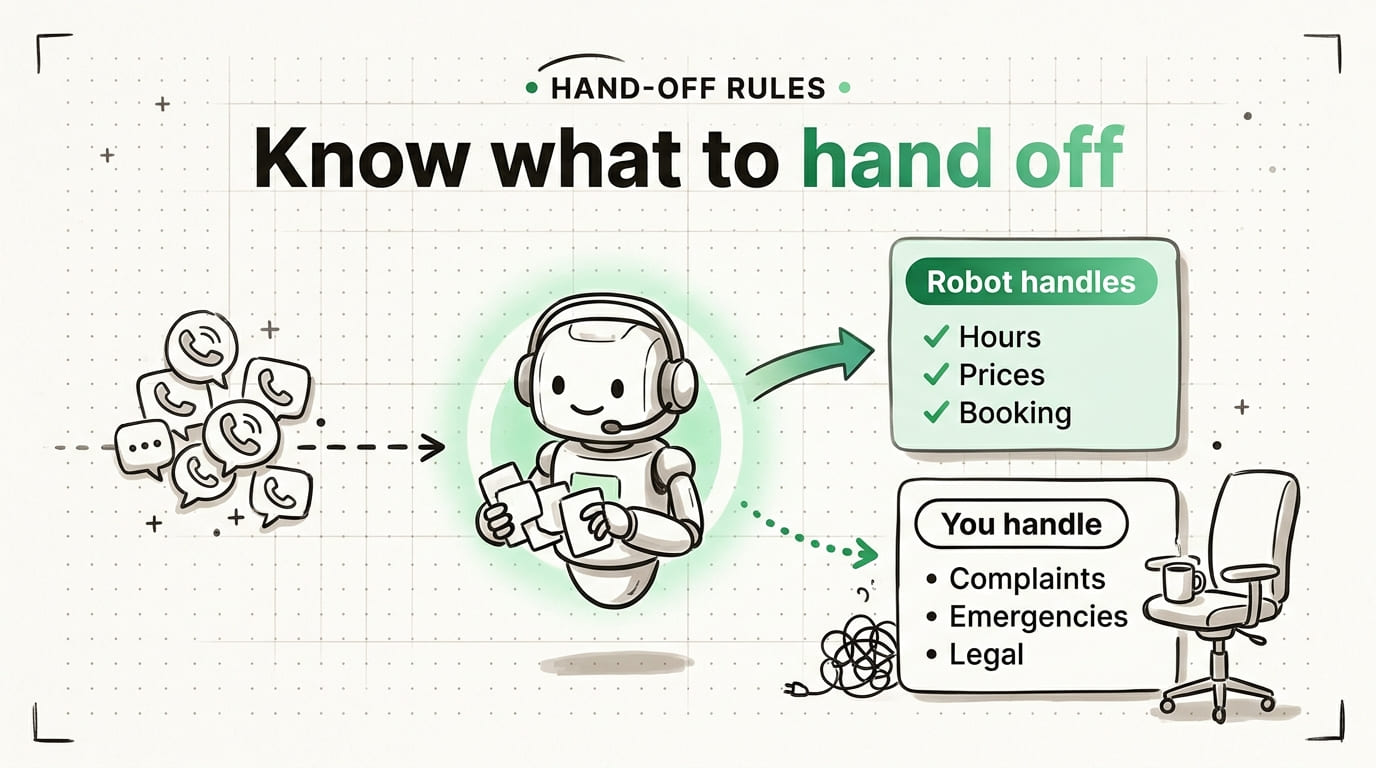
Most calls are the same handful of questions: opening hours, prices, location, parking, and "are you taking new clients?" An AI receptionist answers these in seconds, using the facts you give it. Your team can then focus on the people standing in front of them.
Booking, order tracking and after-hours triage are ready for real use today [2]. When the assistant is connected to your calendar, the caller picks a time and gets a confirmation straight away. Automated reminders can also cut no-shows by 20 to 35% [2], which matters a lot for clinics, salons and service businesses where an empty slot is lost money.
Not every call can be solved on the spot. A good assistant collects the name, number and reason for the call, then sends you a clean summary. Good starting points are FAQs, approved message intake and calendar booking [3]. You wake up to a short list of real enquiries instead of a pile of missed calls.
Nobody likes waiting. In one 2026 survey, 35% of people said avoiding hold time is the reason they prefer AI [1]. A fast answer, even from a machine, often beats a long wait for a human.
It should not judge these alone [3]. If a caller describes a medical emergency, a legal threat or a safety risk, the assistant must stop and pass the call to a person or the right emergency service right away.
It can stumble when a caller is upset or has several problems at once. Only one in four customers prefers a voice bot for complex issues [2]. An angry customer wants to feel heard, and a script rarely does that well.
Thick accents, background noise and unusual names can cause errors [2][3]. Make sure the assistant repeats names, numbers and dates back to the caller before it confirms anything.
Wrong business info in means wrong answers out [3]. If your prices changed last month and nobody updated the assistant, it will quote the old price with full confidence.
A person must own every callback [3]. The assistant can flag a hot lead, but someone on your team still has to call back and close the deal.
Tell callers it is an AI. In the EU, the duty to tell people they are dealing with an AI system took effect on 2 August 2026 [4][5]. Australia's privacy regulator also says public-facing chatbots should be clearly identified as AI, and your privacy policy should explain how you use it [6].
Honesty is good business too. In one survey, 37% of people said they later found out that a "human" they spoke to was AI [1]. Nobody likes that surprise. A simple opening line works well: "Hi, I'm the virtual assistant for [Business]. I can help with bookings and questions, or connect you to a person."
Be careful with personal data as well. Collect only what you need, tell people how their details will be used, and keep call records and messages secure.
Start small: Pick 5 to 10 common questions plus booking. Do not try to cover everything on day one.
Give it your real info: Prices, hours, service areas and rules. Keep them current.
Set hand-off rules: Emergencies, complaints and "I want to talk to a person" should go straight to you or your team.
Test it like a customer: Call it, chat with it, speak fast, ask strange questions, and try to break it before real customers do.
Review calls every week for the first month: Regulators warn against "set and forget" [6]. Fix wrong answers and add the questions it missed.
Grow slowly: Once it works well on one channel, add WhatsApp, Instagram or more services.
It depends on how many calls and chats you lose today. If you rarely miss a call, you may not need one yet. If enquiries slip away at night, on weekends or during busy hours, it can pay for itself quickly.
A simple check: for one week, count the calls you could not answer. Multiply that by the average value of one customer. If the number hurts, an AI receptionist is worth a serious look.
Treat an AI receptionist as a first responder, not a replacement. It catches the calls you would miss and passes the hard ones to you. The businesses that get the best results are the ones that keep it honest, keep it updated and keep a human close.
If you want one on your website, WhatsApp or Instagram, with booking and a human hand-off, DevDeer Tech builds and tunes them. Visit devdeer.tech to learn more.
General information, not legal advice. Check the rules in your country.
Some sources are AI vendors, so treat their numbers as indicative.
SchedulingKit. "35 AI Receptionist & Virtual Assistant Statistics (2026)" (cites Invoca 2026). https://www.schedulingkit.com/statistics/ai-receptionist-statistics
Quidget. "Voice AI for Customer Support: Hype or Ready for Prime Time? (2026 Honest Assessment)" (cites Accenture and PwC). https://quidget.ai/blog/ai-automation/voice-ai-for-customer-support-hype-or-ready-for-prime-time-2026-honest-assessment/
Trillet. "Do AI Receptionists Still Need Human Backup in 2026?" https://trillet.ai/blogs/do-ai-receptionists-need-human-backup-2026
Mondaq. "Not delayed, not deferred: EU AI Act transparency obligations are now in force." https://www.mondaq.com/uk/compliance/1826042/not-delayed-not-deferred-eu-ai-act-transparency-obligations-are-now-in-force
EU AI Act. "Article 50: Transparency obligations for providers and deployers of certain AI systems." https://artificialintelligenceact.eu/article/50/
OAIC (Australia). "Guidance on privacy and the use of commercially available AI products." https://www.oaic.gov.au/privacy/privacy-guidance-for-organisations-and-government-agencies/guidance-on-privacy-and-the-use-of-commercially-available-ai-products
A voice or chat assistant that answers calls and messages for your business, books appointments and takes messages, at any hour.
Not fully. It handles routine questions and booking well. People should handle complaints, emotional calls and anything involving safety, legal or medical advice.
In the EU, yes, unless it is obvious from the context (Article 50). In Australia, the privacy regulator says public-facing chatbots should be clearly identified as AI.
Yes, if it is connected to your calendar. Booking and confirmations are among the most reliable jobs for an AI receptionist.
A good setup hands the call or chat to a person, or takes a message and flags it for a callback. Set these rules before launch.
A basic setup with your common questions and booking can be ready in days. Tuning it with real calls takes a few weeks