
DevDeer TechLoading
Product
 Kaies Mahmud Nehal1 min read
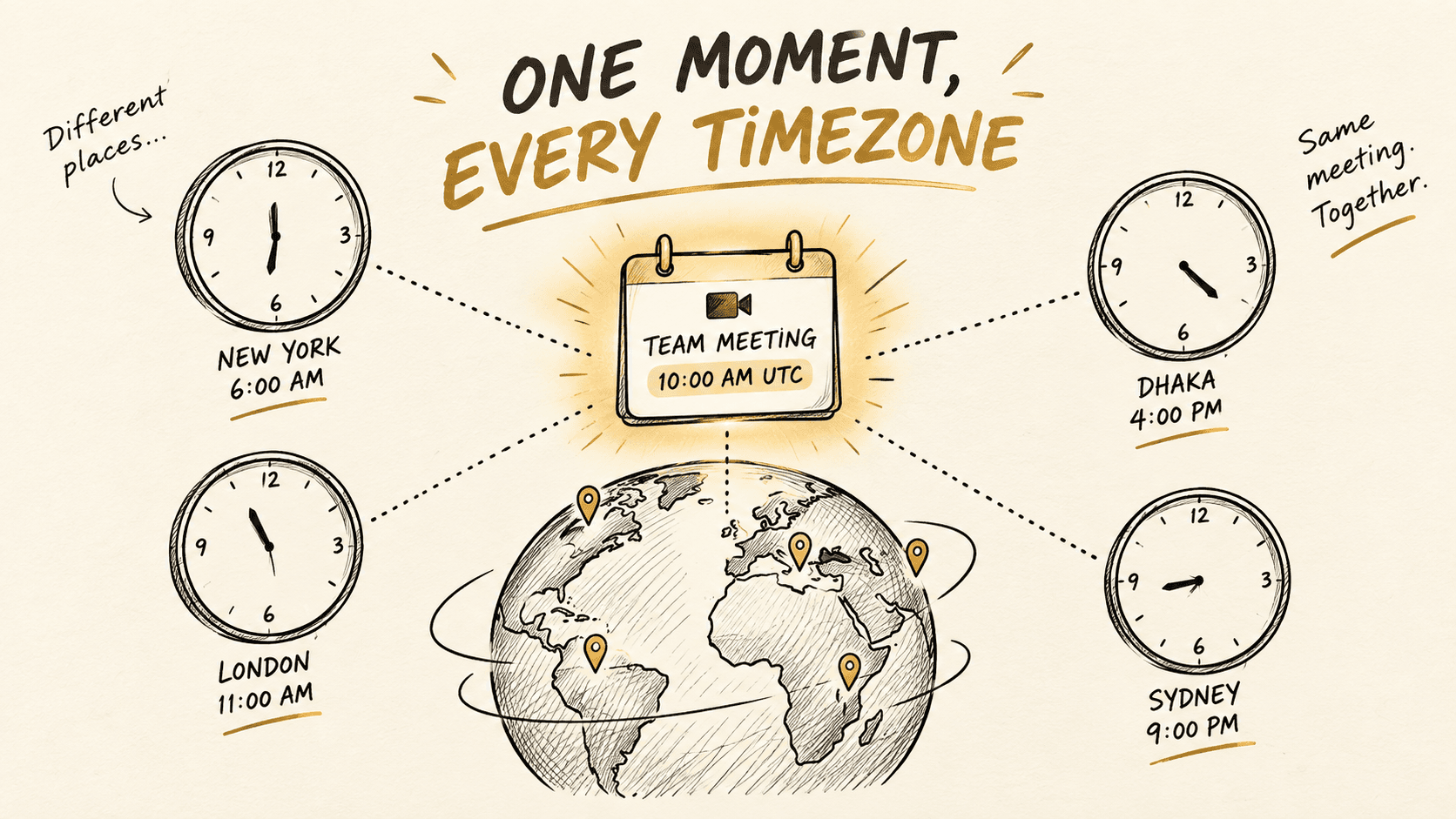
We are based in Australia. A lot of our clients are in Europe. Some are further out. That means almost every meeting we schedule crosses at least one timezone, and often two or three.
If you have ever shown up to a call an hour early because a tool assumed the wrong offset, you know how much trust a single mistake costs. So when we built our own scheduler, timezone correctness was not a feature. It was the whole point.
What we got right: Every meeting stores one true moment in time. Each person sees it rendered in their own timezone, which they set once in their profile. The client in Berlin sees 3pm. We see 7pm. Nobody does mental math. Nobody is late.

Reminders that actually arrive: A background job fires reminders ahead of the meeting, in the attendee's local time, over email and push. When a meeting is cancelled, the reminder is cleaned up so nobody gets a ping for a call that is not happening.
The lifecycle is explicit: A meeting is scheduled, then either ends or is cancelled. No ambiguous states, no guessing whether a slot is real.
It sounds simple written down. Getting it right took careful work at the data layer, because the easy version, storing a local time and hoping, breaks the first time daylight saving shifts. We store the instant, convert at the edges, and let each person live in their own clock.
Small thing. Huge difference to how a working relationship feels.
One wrong offset means someone joins an hour early or misses the call. A single mistake costs trust, so accuracy has to be the core of the product, not an add-on.
Each meeting stores one exact moment in time (a UTC instant). It is converted to local time only when displayed
Local times are ambiguous. When daylight saving shifts, a stored "3pm" can silently point to the wrong moment. Storing the instant avoids that.
Each person sets their timezone once in their profile. The same meeting then shows as 3pm in Berlin and 7pm in Australia with no mental math.
A background job sends reminders ahead of the meeting by email and push, timed to the attendee's local clock.
They are cleaned up automatically, so nobody gets pinged for a call that is not happening.
Scheduled, ended, or cancelled. There are no ambiguous states, so you always know whether a slot is real.
Yes. Because the instant is stored and conversion happens at display time, DST shifts do not move or break existing meetings.
Yes. We build scheduling, reminder, and notification systems with timezone-safe data models. Get in touch to discuss your requirements.